Alaska Mini Split Pros

Adding a mini split to an Alaska home with a furnace

A white wall-mounted mini-split air conditioner indoor unit shown straight-on against a plain light gray background.
Match me with a pro

A mini split can go in alongside your furnace without replacing it, and in most Alaska homes that's exactly how it's done. The furnace keeps handling the deep cold, since a mini split's output drops off once temperatures fall far below freezing. What the mini split adds is cooling for summer, when it can run hot and dry here, plus efficient heat in the shoulder months when you don't need the furnace running full time. The two systems don't fight each other. They're set up on separate controls, so you run the furnace when it's genuinely cold and switch to the mini split when it isn't. Getting that balance right, and sizing the unit for the rooms you actually want cooled or warmed, is the part that needs someone who installs these in homes like yours and knows where they're placed, how they're wired in, and what keeps them working through an Alaska winter.

A woman with shoulder-length brown hair wearing a beige knit cardigan sits in a gray upholstered armchair near a window, looking off to the side with a slight smile, with bookshelves blurred in the background.
A woman and a sleeping child wrapped together in a cream knitted blanket on a couch, with a potted plant, framed photo and lit lamp in the background.

What the mini split takes on

A mini split handles the shoulder months, the stretch in spring and fall when the furnace would otherwise cycle on for a space that only needs a few degrees of help. It also covers cooling, which gas heat was never built to do. Since Alaska summers run hot and dry, that's the load most furnaces here were never asked to carry. Run in cooling mode, the same unit pulls moisture and heat out of the air it's installed in, no ductwork required, and does it on electricity instead of gas.


Why the furnace stays in charge

A mini split's heat output falls as the outdoor temperature drops, and below a certain point it can't keep up with a cold snap on its own. The furnace doesn't have that limit. It burns gas to make heat directly, so it holds steady output no matter how far the temperature falls outside. That's the deep cold most of Alaska sees for stretches of the winter. Keeping the furnace as the backup for those weeks means the house still has a heat source that doesn't lose capacity when it's needed most.

A man with grey hair and stubble in a dark sweater sits on a grey sofa indoors, looking off to the side, with a potted plant and a sunlit window behind him.
A man with gray hair, a beard and glasses, wearing a dark green sweater, sits on a gray sofa in a sunlit living room with a potted plant, table lamp and wooden sideboard behind him.
A middle-aged man with graying hair and a short beard sits on a blue sofa in a living room, looking toward a window, with a bookshelf, lamp and framed picture in the background.
A man with graying curly hair and a dark green sweater sits on a gray sofa in a sunlit living room, looking off to the side, with a framed picture, shelving, an armchair and a window with sheer curtains behind him.

One zone

A single indoor unit covers the room you use most, often the living room. Good fit if you mainly want relief from summer heat and lighter furnace use in spring and fall.

Find a licensed pro

Multiple zones

One outdoor unit can run several indoor heads in different rooms. Costs more upfront but covers more of the house for both summer cooling and shoulder season heat.

Find a licensed pro

Furnace Alone or Furnace Plus Mini Split

Furnace alone

  • Gas heat keeps working the same way it always has, with no new equipment to learn or maintain.
  • It has no trouble holding the house warm once temperatures drop well below freezing, which is where a mini split's output falls off.
  • Summer cooling isn't part of the picture, so hot dry stretches are handled with fans or open windows or not at all.
  • Every degree of spring and fall heating still comes from the furnace cycling on, even for a single room that barely needs it.
  • There's nothing to size, place, or wire, since the system already in the house stays exactly as it is.

Furnace plus mini split

  • The furnace still takes over for the coldest stretch of winter, so nothing about deep cold heating changes.
  • Spring and fall, the mini split can cover a room on its own instead of the furnace cycling for the whole house.
  • Summer cooling becomes possible in whichever rooms have an indoor head, which gas heat was never built to provide.
  • Electricity use goes up some months, and power here runs expensive, so it's worth knowing which rooms will actually use it before adding zones.
  • A contractor familiar with Alaska homes can place the outdoor unit and size the system so it pulls its weight without being asked to replace the furnace.
A white wall-mounted mini-split air conditioner near the ceiling of a room with light gray walls, white crown molding, and a beige curtain at the left edge.

Installed and running clean

This is what a mini split should look like on your wall, set high, flush against the surface, drawing air through a clean coil. In the dry summer heat here, a unit installed right keeps pulling its weight without strain.

A dusty beige wall-mounted mini-split air conditioner indoor unit installed high on a plain light-colored wall below the ceiling.

What neglect looks like

Dust and grime like this build up when the filter and coil never get checked. The staining above the unit points to a condensate line that isn't draining the way it should, a sign the install or upkeep missed something.

A white wall-mounted mini-split air conditioner indoor unit installed near the ceiling on a plain light-colored wall, with its horizontal outlet vent and louvers visible.
Before you get your mini split installation
A white wall-mounted mini-split air conditioner on a beige interior wall, with a curtained window on the left and wood flooring with a light rug below.
After you get your mini split installation
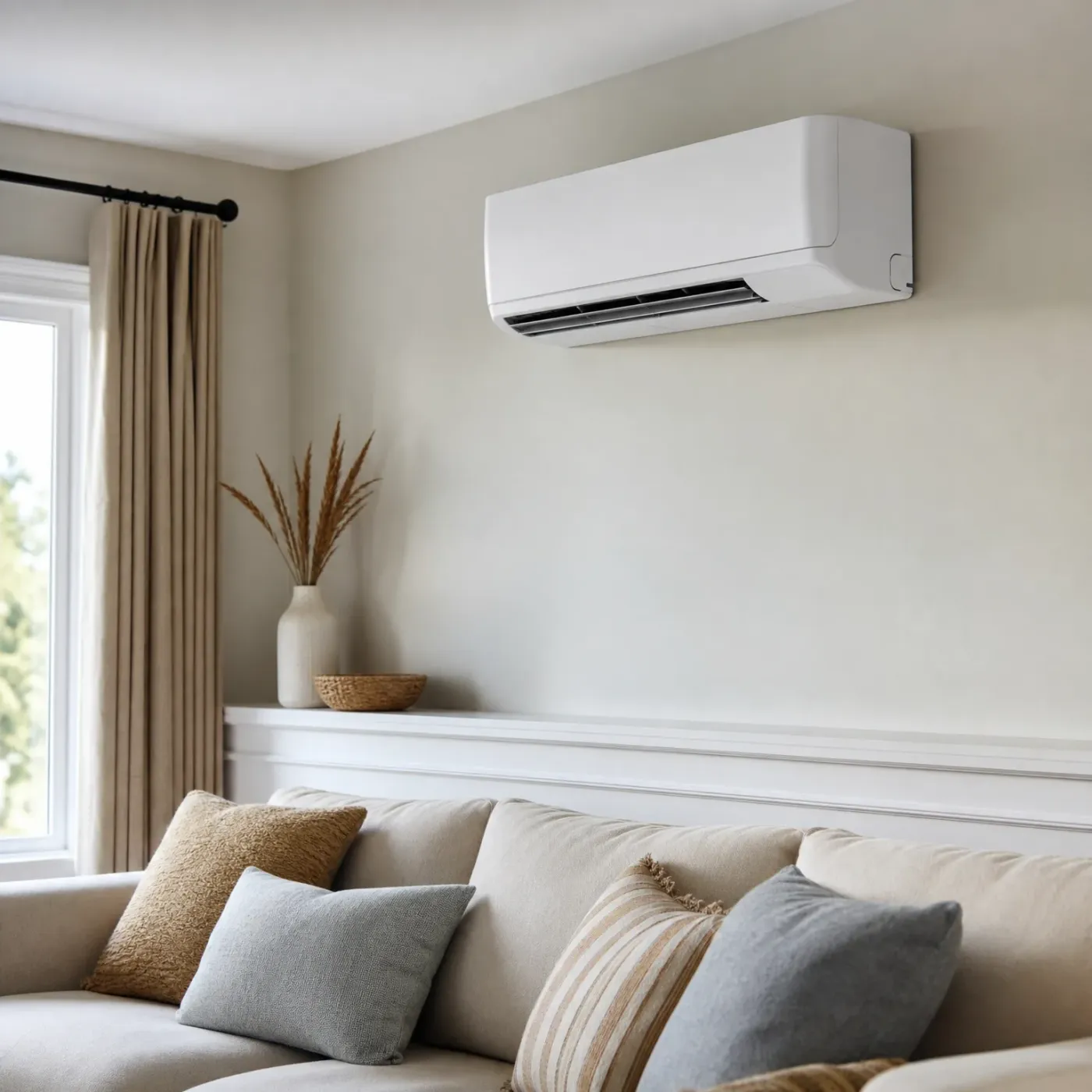
A white wall-mounted mini-split air conditioner on a pale wall above a beige sofa with assorted cushions, beside a window with long curtains and a shelf holding a vase of dried grasses and a woven bowl.

Get your mini split to the right pro

Only one pro gets your request, so you hear from one company.

Describe your mini split job, and a local pro who handles it gets in touch.

Find a local pro

No fee to send it, and nothing to sign.

A white wall-mounted mini-split air conditioner on a beige interior wall, next to a window with sheer white curtains and green foliage outside.
A mini split mounted high and level, coil clean, pulling in air without a fight during Alaska's dry summer heat.
A dusty, discolored wall-mounted mini-split air conditioner indoor unit on a plain white wall, with its horizontal louvers and vent grille visible.
Dust caked across the top and vents like this cuts airflow and makes the unit work harder to cool the room.
  1. A technician sizes each room's load before picking equipment

  2. The outdoor unit gets mounted on a bracket or pad

  3. A line set carries refrigerant through a wall port to each indoor head

  4. The indoor head is hung high on the wall and leveled

Power costs 26.11 cents per kilowatt-hour statewide

At that rate, the hours your mini split runs add up fast on the bill. Since it's handling cooling and taking cycles off the furnace rather than replacing it outright, the savings show up in how little extra power it takes to cover what gas heat can't.

EIA-861 2025 statewide residential average

A woman in a cream cardigan and jeans stands with one hand raised facing an open front door of a gray horizontal-siding house, with a black lantern wall light, a potted shrub with yellow flowers, and a stone-faced porch column.

A mini split added to the furnace, not instead of it

The furnace keeps the house warm through the hard cold. The mini split takes the months on either side of it, plus the summer heat the furnace was never meant to touch. Put together, that's one system covering what the other can't, running on an electric rate that costs more per hour than gas, which is why the mini split's job is to take on cycles, not take over.

Whether that's one indoor head in the room you use most or several covering different parts of the house, it has to go in right to pay off, mounted level, drawing clean air, sized to the room it's serving. A local installer who works on this equipment through an Alaska summer and an Alaska winter knows where that goes wrong and how to size it so it doesn't. When you put in a request, you're matched with one contractor who takes on your specific setup, furnace included, and reaches out directly. No list of companies calling, just the one who fits the job.

A living room corner with a light beige sofa holding a textured taupe cushion, a large ceramic vase of olive branches by a window, a framed neutral artwork on the wall, and a dark bowl with stacked books in the foreground.
At dusk, a dark board-and-batten house with a standing-seam metal roof and lit entry walkway of stone pavers, with two large outdoor heat pump units on a stone-walled pad at right and trees and hills in the background.

Mini Split Installation

The right pro for this job

Step 1 of 3: Equipment
  • A beige upholstered armchair with an olive cushion sits in a sunlit corner beside a wooden side table holding a ceramic vase with leafy branches, under a framed abstract artwork, on a woven rug over a wood floor.
    • Say what's going on with your mini split, and a pro who works on them reaches out.
  • A gray outdoor condenser unit on a concrete pad surrounded by dark gravel, beside a dark wood-sided wall with an electrical disconnect box and a stone veneer wall with a small evergreen shrub.
    • Send the request and finding a pro stops being your problem.
    • After this form, you can stop searching for a mini split pro.
  • A beige upholstered oversized armchair with a matching cushion and a knit throw draped over one arm, beside a round wooden side table holding a vase of greenery near a curtained window, with a framed landscape print on the wall and a woven rug on a wood floor.
    • Skip the round of in-home estimates for a new mini split.
    • Describe the project once instead of to every installer.
  • Sunlit living room corner with a beige upholstered sofa, cushion and knitted throw, a round wooden side table holding a white ceramic vase of leafy branches and a small wooden bowl, a framed landscape painting on the wall, and a window at right.
    • Your request goes to one pro, not a list of companies.
    • One installer gets your project, so there's no bidding war over it.